


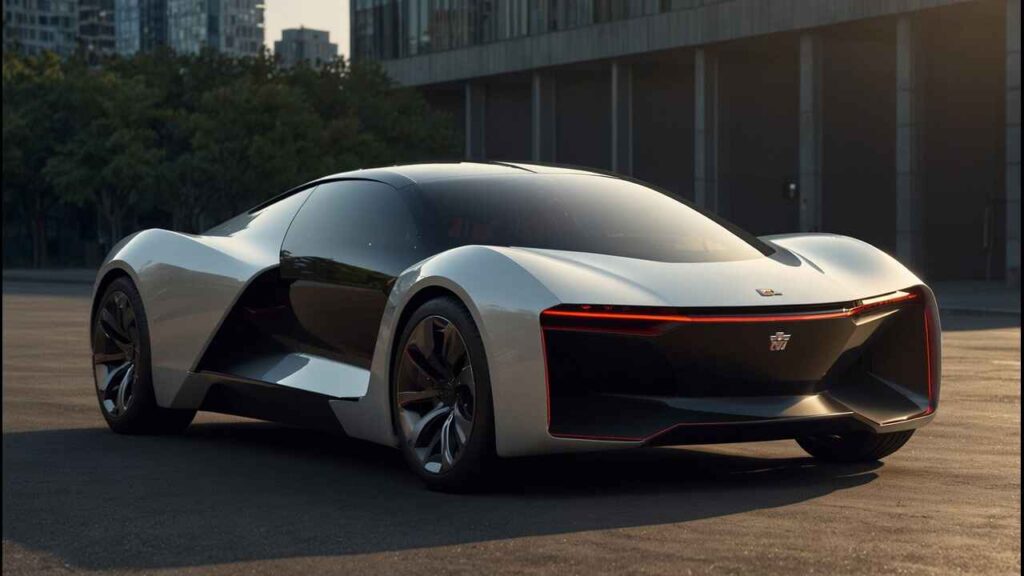
GM’s California Corvette Concept has unveiled , an innovative all-electric hypercar designed by GM’s Advanced Design studio in Pasadena. This one-off concept pays homage to Southern California’s iconic car culture while pushing the boundaries of automotive design into the electric future.
A Radical Design, Reimagining the Corvette
Unlike a typical production teaser, the California Corvette Concept is purely a design exercise—an artistic exploration of what a Corvette could become in an electric era. Its most striking feature is a single-piece, front-hinged canopy that replaces conventional doors and roof, opening up the entire cabin. This design allows the car to transform effortlessly from a sleek coupe into an agile, open-air track machine.
Brian Smith, Design Director at GM Advanced Design Pasadena, describes the project as blending “Southern California’s automotive legacy with a futuristic perspective.” The concept embodies a duality of purpose—combining agile sports car dynamics with the openness of a lightweight track vehicle. GM’s global design team is producing three Corvette-based concepts in 2025, with this being the second, following the UK studio’s model unveiled earlier this year.
Technical Innovations Beneath the Skin
The California Corvette features a T-shaped prismatic battery pack that enables a low seating position and optimizes airflow throughout the chassis. Although GM has not disclosed full technical specifications, the concept includes a carbon fiber monocoque chassis that reduces weight and enhances structural integrity.
At the rear, the concept boasts an active spoiler and air brake to improve high-speed stability and aerodynamic efficiency. Large staggered wheels—21 inches at the front and 22 inches at the rear—enhance the car’s aggressive stance and handling prowess.
The dimensions emphasize a racing-inspired profile: a length of 182.5 inches (4,669 mm), a width of 86 inches (2,184 mm), and a relatively low height of 41.4 inches (1,051 mm), complemented by a 109-inch (2,767 mm) wheelbase.
Inside the Minimalist, Driver-Centric Cockpit
The cabin design adopts a minimalist, performance-focused approach. Integrated structural elements and a racing simulator-inspired layout center the driver’s experience. Seats are mounted directly to the carbon-fiber tub, reinforcing the lightweight ethos.
An augmented reality heads-up display (AR HUD) stands out as a futuristic feature, projecting essential driving data directly onto the windshield, ensuring the driver remains focused during high-speed driving without distraction.
Celebrating Corvette Heritage with a SoCal Twist
GM’s advanced design team situates the California Corvette deeply within Southern California’s rich automotive culture, infusing the concept with regional character. The glossy textured rear panel and redesigned camera module carry subtle nods to Corvette’s lineage while reflecting a bold, contemporary vision.
Bryan Nesbitt, GM’s Vice President of Global Design, emphasized the collaborative nature of this global effort. “We invited multiple GM studios to envision Corvette-inspired hypercars, and the California team delivered a stunning design that honors Corvette’s legendary performance.”
More Than a Concept: A Glimpse Ahead for Corvette’s Electric Future
While the California Corvette Concept is not intended for production, it symbolically signals GM’s direction for the Corvette brand beyond traditional combustion engines. Rather than a simple EV adaptation, this concept suggests a radical rethinking of Corvette identity, emphasizing innovation, agility, and immersive driving experience.
GM’s Pasadena Studio: A Hub for Cutting-Edge Design
The California Corvette was developed in GM’s Pasadena studio—a sprawling 148,000-square-foot facility housing approximately 130 design and creative staff. The studio plays a critical role in GM’s worldwide design network, which includes sites in Detroit, Shanghai, Seoul, the UK, and Los Angeles.
Equipped for advanced physical modeling, sculpting, and fabrication, Pasadena serves as a creative heartbeat where visionary projects like the California Corvette originate.
GM’s California Corvette Concept encapsulates the heritage and future of America’s sports car icon. With daring design choices—like its canopy cockpit and prismatic battery layout—coupled with state-of-the-art aerodynamics and driver-focused technology, it offers a tantalizing vision for the electric age. Though purely conceptual, it loudly proclaims the possibilities ahead for Corvette in 2025 and beyond.
Certainly! Here is a detailed specifications table for GM’s California Corvette Concept followed by a catchy headline under 60 characters.
GM’s California Corvette Concept – Detailed Specifications
| Feature | Specification |
|---|---|
| Design Studio | GM Advanced Design, Pasadena, California |
| Concept Type | One-off all-electric hypercar design study |
| Key Design Feature | Single-piece, front-hinged canopy replacing doors and roof |
| Body Structure | Lightweight carbon fiber monocoque chassis with tunneled underbody |
| Battery Pack | T-shaped prismatic battery pack for low seating and optimized airflow |
| Aerodynamics | Active rear spoiler and air brake for high-speed stability |
| Wheel Size | 21-inch front wheels, 22-inch rear wheels |
| Dimensions | Length: 182.5 in (4,669 mm) |
| Width: 86 in (2,184 mm) | |
| Height: 41.4 in (1,051 mm) | |
| Wheelbase: 109 in (2,767 mm) | |
| Interior | Minimalist, driver-centric cockpit with integrated structural elements |
| Display | Augmented Reality Heads-Up Display (AR HUD) |
| Performance Tech | Aerodynamic optimization with active aero components |
| Special Features | Convertible canopy enabling transition from closed sports car to open-air track car |
| Production Status | Concept only, no current plans for production |